Catholic Social Teaching
What is catholic Social Teaching?
Catholic Social Teaching is a set of principles from the Catholic Church that guide how we treat others and build a fair society. Catholic Social Teaching is about human dignity and the belief that every person is valuable and deserves respect. Catholic Social Teaching emphasises caring for the poor and vulnerable, promoting peace, protecting the planet, and working for the common good. Catholic Social Teaching is Faith in Action: loving each other not just in words, but through justice, compassion, and real-world change.
At St James we follow the nine principles of Catholic Social Teaching:
-
Common Good: Society should be structured in ways that benefit all people, promoting the wellbeing and flourishing of every individual and community.
-
Option for the Poor: The Church is called to prioritize the needs of the poor and vulnerable, recognizing that their well-being is essential to the overall health of society.
-
Solidarity: All people are interconnected and share a responsibility for one another's welfare, requiring us to stand with and for those in need.
-
Dignity of Work: Work is more than a means of earning a living; it is a dignified participation in God's creative work, requiring fair wages and respect for workers' rights.
-
Dignity of the Family: Family life is fundamental to a well-ordered society and is central to human development, calling for support and respect for family structures.
-
Care for Creation: The Earth is a sacred gift, and humans have a responsibility to protect and cherish it for present and future generations.
-
Human Dignity: Every person is made in the image of God and possesses an inherent dignity that must be respected and safeguarded.
How is Catholic Social Teaching woven through the curriculum at St James?
At St James Catholic Social Teaching is embedded in every part of the curriculum because it shapes not just what our children learn, but who they become. It encourages students to see every curriculum subject through the lens of human dignity, justice, and responsibility. By weaving these principles throughout the curriculum it helps the children at St James to connect knowledge with values, think critically about real-world issues, care for others, and understand their role in building a fairer society. It’s about forming compassionate, socially aware young people, not just teaching content.
You can find our Catholic Social Teaching principles within our curriculum below:
Catholic Social Teaching MFL
At St James’ Catholic Primary School, the seven principles of Catholic Social Teaching are embedded throughout the MFL curriculum through art, storytelling, discussions and cultural exploration, helping students understand their global responsibility while improving language skills. By embedding CST values into our MFL curriculum children develop their language skills, while learning to be caring responsible global citizens.
| Principle | Curriculum Focus |
| Dignity of the Human Person | Every person has an intrinsic value because they are made in the image of God. In learning French, children discover the importance of respecting different cultures and people, recognising that every individual deserves respect regardless of their nationality or language. This principle encourages us to see beyond stereotypes and appreciate the unique story behind every person we meet through language. “Tu as du prix à mes yeux, tu m’es précieux.” (Ésaïe 43:4) “You are precious in my eyes, and honoured, and I love you.”(Isaiah 43:4) |
| Solidarity | Standing together with others, especially those suffering or in need. Language learning builds bridges across cultures, fostering understanding and shared responsibility. It encourages children to see themselves as part of a global community committed to justice and peace. ‘’Soyez dévoués les uns aux autres dans l'amour. Honorez les autres plus que vous-mêmes. ‘’ (Romains 12:10) “Be devoted to one another in love. Honour one another above yourselves.” (Romans 12:10) |
| The Common Good |
The common good refers to the social conditions that allow individuals and communities to flourish. In an MFL classroom, learning languages promotes mutual understanding and cooperation between cultures. It encourages children to think about how their knowledge can contribute to building more peaceful and inclusive communities. ‘’Tu aimeras ton prochain comme toi-même.’’ (Matthieu 22:39) “You shall love your neighbour as yourself.” (Matthew 22:39) |
|
Option for the Poor and Vulnerable |
Preferential Option for the Poor and Vulnerable" is a core principle of Catholic Social Teaching (CST) that instructs believers to prioritize the needs of the marginalized, poor, and vulnerable. It emphasizes that this is a matter of justice rather than just charity, calling for structural changes to tackle the root causes of poverty. In the context of Modern Foreign Languages (MFL) education, this principle can be applied in several ways:
|
| Peace and Reconciliation | Peace is more than the absence of conflict; it involves justice, respect, and reconciliation. Learning languages helps children understand diverse perspectives and resolve misunderstandings peacefully. It encourages dialogue and cooperation among people from different backgrounds. ‘’Heureux les artisans de paix.’’ (Matthieu 5:9) “Blessed are the peacemakers.” (Matthew 5:9) |
| Creation and Environment | Stewardship means caring responsibly for the world God has given us, including the environment and its resources. Language learning offers opportunities to explore how different cultures relate to nature and the planet. It encourages students to reflect on how their actions affect others and future generations, fostering a global sense of responsibility. L’Éternel, le Dieu de tes pères, te donnera la terre.” (Deutéronome 1:8) “The Lord your God will give you this land.” (Deuteronomy 1:8 |
|
Dignity of Work and Participation |
MFL focuses on promoting intercultural understanding and "languages for all" as part of their contribution to Catholic Social Teaching. Children in languages explore how work is viewed in other cultures, the impact of migration on work, and the importance of Fair Trade. In essence, MFL in this context teaches children to see workers across the globe as brothers and sisters, advocating for justice and recognizing the value of work in all its forms. |
Catholic Social Teaching PSHE
At St James’ Catholic Primary School, the seven principles of Catholic Social Teaching are embedded throughout the personal, health and social curriculum, providing students with opportunities to reflect on the ethical, social and moral dimensions of personal, health and social education. This approach ensures students develop a deeper understanding of global responsibility, environmental stewardship and social justice. The following outline shows how each principle is integrated across different year groups through discussions, debates and classroom activities.
| Principle | Curriculum Focus |
| Dignity of the Human Person | We believe that every person is created in the image and likeness of God, deserving of respect and dignity. In our school, we promote kindness, inclusivity, and compassion, ensuring that each child feels valued and supported. For instance, our anti-bullying initiatives and peer support programs encourage students to embrace and celebrate each other’s uniqueness. Our ‘Identity, Society and Equality’ topics run through all year groups and cover themes such as: Me and others (Year 1); Respecting ourselves (Year 2); Celebrating differences (Year 3); Democracy (Year 4;) Stereotypes (Year 5) and Human rights in Year 6. Children are also encouraged to look after their physical and emotional well being and support others in this too. |
| Solidarity | We are called to stand in solidarity with one another, recognising our interconnections as a community. In PSHE, pupils learn about working together as a community to bring about positive change. |
| The Common Good | The common good in PSHE, particularly within Catholic education, refers to creating social conditions that allow individuals and groups to reach their full potential, emphasizing collective responsibility, empathy, and active citizenship. It focuses on working together to improve societal well-being, caring for the vulnerable, and building community. In practice, we foster this through roles like School Councillors and Eco-Warriors, as well as through our curriculum that highlight empathy, social justice, and stewardship of the environment |
| Option for the Poor and Vulnerable | Throughout our PSHE curriculum, we encourage pupils to think about vulnerable members of our local and wider community. We empower pupils through our anti bullying work and topic threads such as ‘Identity, society and equality’ and ‘Keeping safe and managing risk’ to speak up and act if someone they know, or they themselves, is feeling vulnerable. |
| Peace and Reconciliation | Peace and reconciliation in Personal, Social, Health and Economic (PSHE) education are crucial for fostering a caring, safe, and respectful environment, equipping students with skills to resolve conflict, empathize with others, and understand the importance of rebuilding relationships damaged by conflict. This theme covers both interpersonal conflicts, such as bullying or disputes with friends, and broader societal issues, including prejudice, discrimination, and the impact of war. |
| Creation and Environment |
In PSHE, "Creation and Environment" involves fostering an understanding of ecological responsibility, sustainability, and humanity's impact on the world, while creating a safe, inclusive, and supportive learning space. This topic explores topics like climate change, biodiversity, and ethical choices, empowering pupils to care for their surroundings. Sustainability and Citizenship: Pupils learn about plastic pollution, recycling, and the impact of human activity on the planet.
|
|
Dignity of Work and Participation |
We acknowledge work is a form of participating in God’s creation. We encourage all pupils to have a strong work ethic, both whilst they are in St. James but also in the wider world. We allow our pupils opportunities through our PSHE and wider curriculum to explore different career options and to learn about money and how this can be earned and spent. |
Catholic Social Teaching in Art
At St James’ Catholic Primary School, the seven principles of Catholic Social Teaching are embedded throughout the art curriculum, providing students with opportunities to reflect on the ethical, social and moral dimensions of artistic expression and visual culture. This approach ensures students develop a deeper understanding of global responsibility, environmental stewardship and social justice. The following outline shows how each principle is integrated across different year groups through creative projects, techniques and critical reflection.
| Principle | Curriculum Focus |
| Dignity of the Human Person |
Year 6: Make sculptures of the human body and explore how God made us all unique. Year 5: Draw self-portraits, focussing on identity and learning that every person is made in the image of God. |
| Solidarity |
Year 1: Study female European artist Sonia Delauney; learning that creativity connects people globally. Year 2: Learn to respect cultures different from their own through studying the work of African artist Esther Mahlangu and tribal mask designs. |
| The Common Good | Year 4: Children are introduced to The Book of Kells and the Lindisfarne Gospels which were made to serve the community and bring people together. Children understand the concept of creating beauty for everyone. |
| Option for the Poor and Vulnerable | Year 6: Children explore the work of Shepard Fairey and Barbara Kruger who challenge division, injustice and harmful power structures; exposing unfairness through art. |
| Peace and Reconciliation | Year 2: The exploration of tribal masks helps children connect the links that masks often relate to ritual and harmony within a group. This helps children learn to respect traditions and resolving conflict through understanding. |
| Creation and Environment |
Year 1: Children learn to notice the world and appreciate beauty in nature with an introduction to landscapes. Year 3: Focus on patterns on insects and nature, creating art inspired by Charles Rennie Macintosh. |
| Dignity of Work and Participation |
Year 2: Children study Cezanne and learn that he studied fruit again and again, showing the importance of patience and dedication to his craft. They learn that the artist Mondrian explored careful arrangement and precision; showing that ordinary things are special. |
Catholic Social Teaching in Design and Technology
At St James’ Catholic Primary School, the seven principles of Catholic Social Teaching are embedded throughout the design and technology curriculum, providing students with opportunities to reflect on the ethical, social and moral dimensions of design, innovation and product development. This approach ensures students develop a deeper understanding of global responsibility, environmental stewardship and social justice. The following outline shows how each principle is integrated across different year groups through creative projects, techniques and critical reflection.
| Principle | Curriculum Focus |
| Dignity of the Human Person | Year 4: Children design shoes, celebrating unique, individual style and not conforming to trends – topic inspired by designer Dan Sullivan from Irregular Choice who focusses on self-expression. |
| Solidarity | Year 1: Children design with others in mind, looking at cards for specific occasion and people. |
| The Common Good | Year 5: Design a fairground ride for many people, considering bringing people together, safety and a positive shared experience. |
| Option for the Poor and Vulnerable | Year 4: Designing a low cost, nutritious meal, learning that good food shouldn’t be a luxury. Children take the meal home to share with their family. |
| Peace and Reconciliation | Year 6: Design and make a vegetable curry, learning about foods from other countries and cultures which helps build and understanding of others. |
| Creation and Environment | Year 3: Children consider the carbon footprint of fruit when designing a fruit crumble. They select seasonal and locally grown options in order to reduce their carbon footprint and look after the planet. |
| Dignity of Work and Participation |
Year 2: Children work collaboratively to design a textile blanket – focussing on shared decision making, teamwork, listening to others’ ideas and peer evaluation. Year 6: Designing phone cases, considering and respecting the needs, preference and wellbeing of different consumers. |
Catholic Social Teaching in Maths
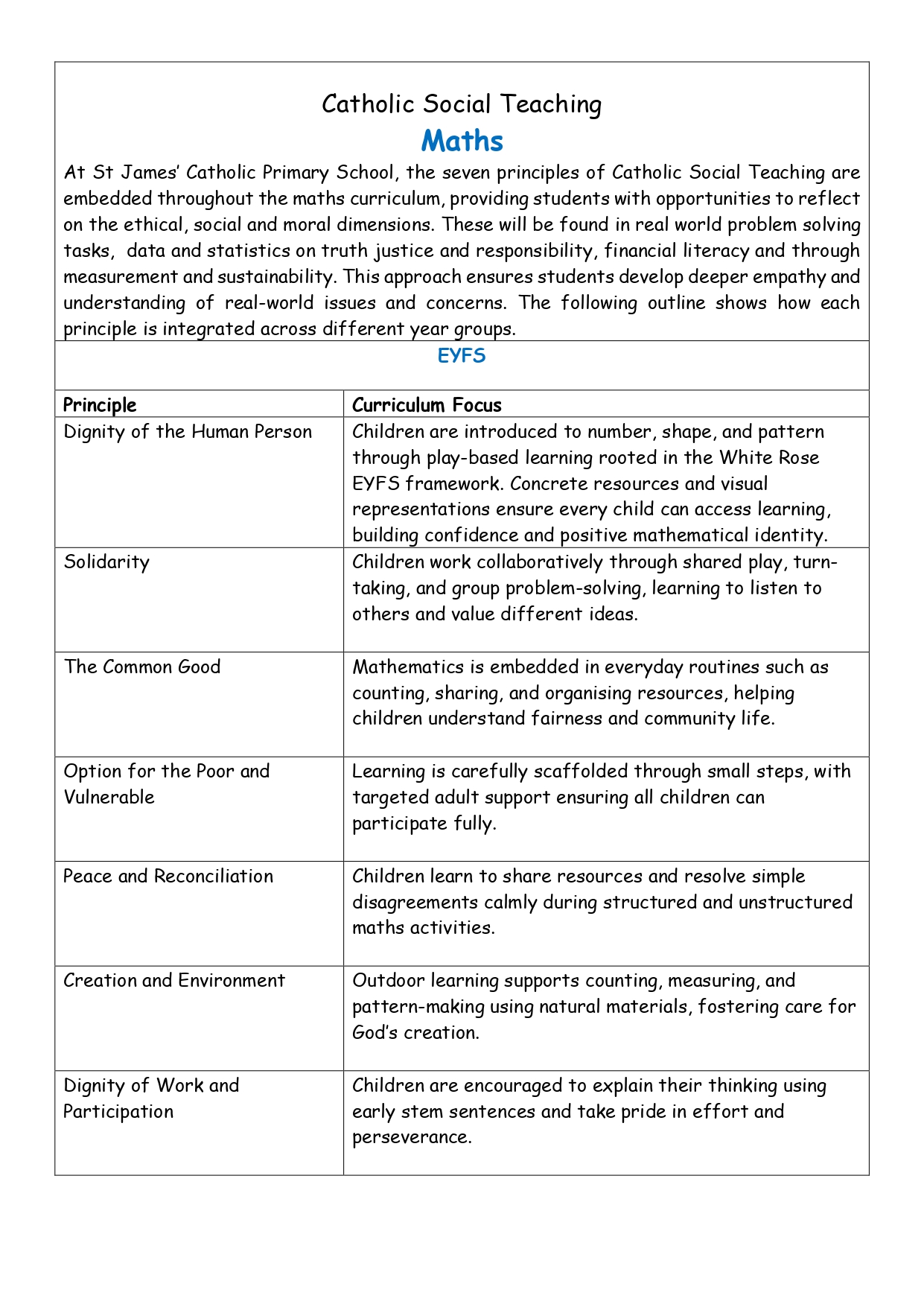
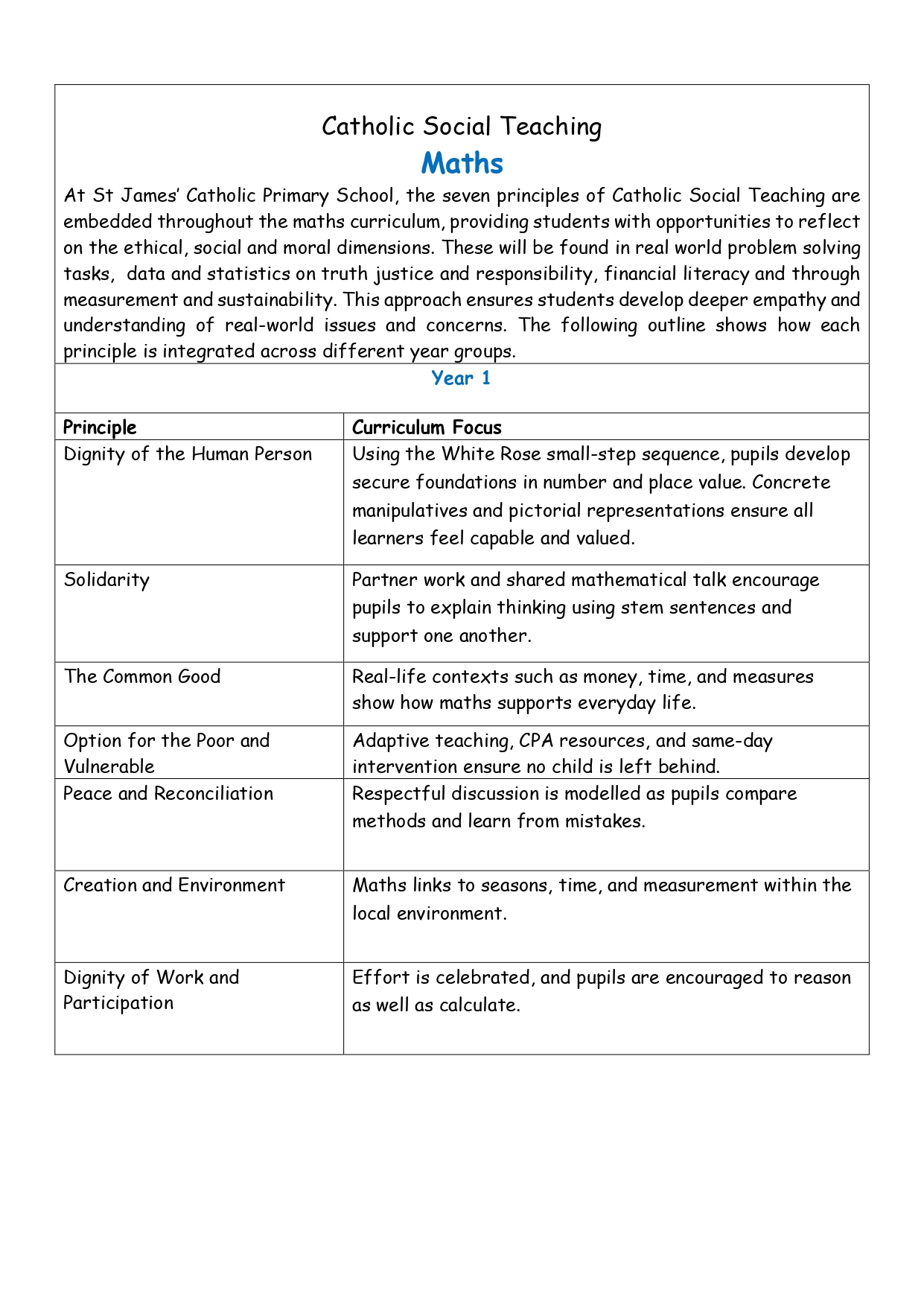
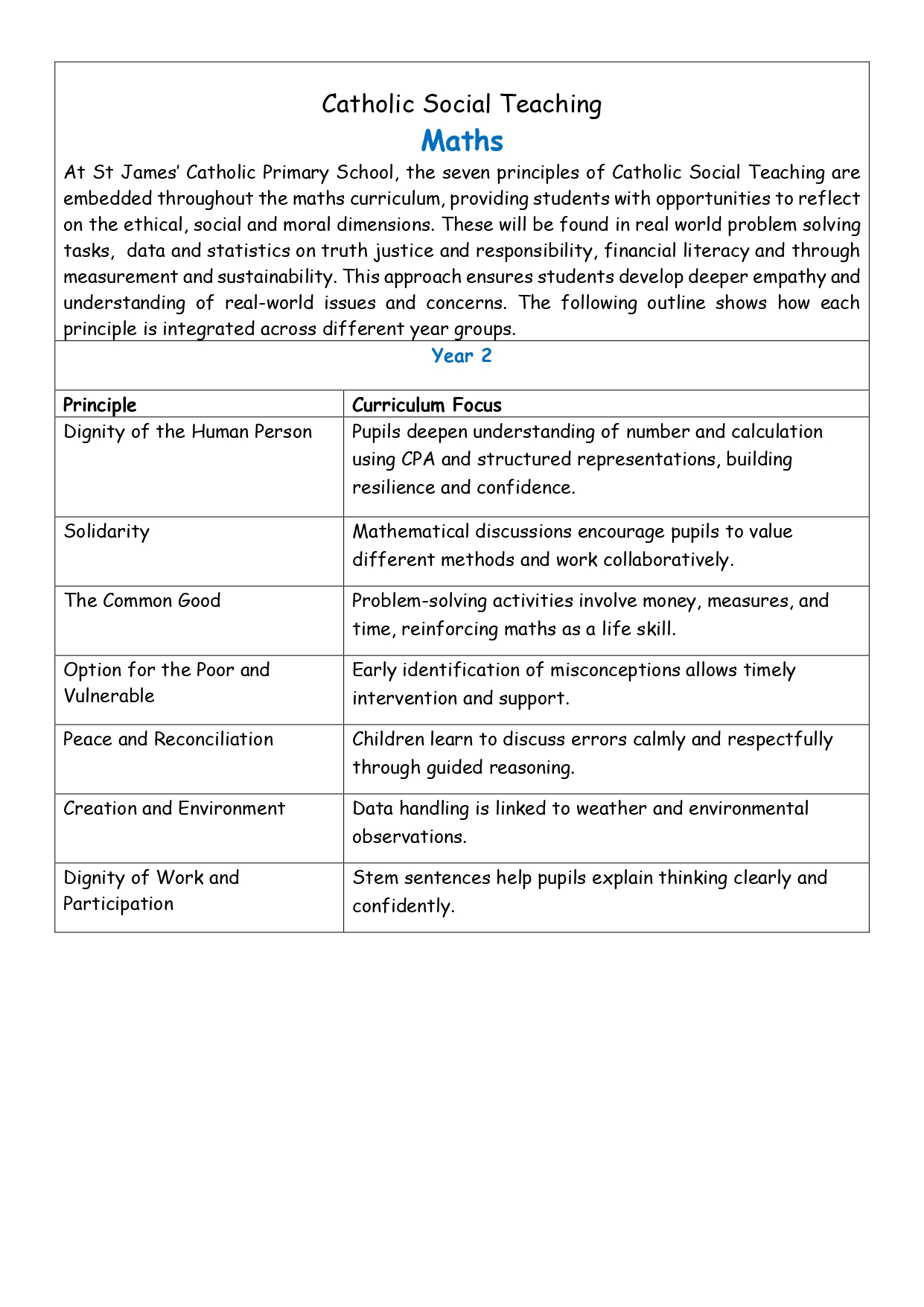
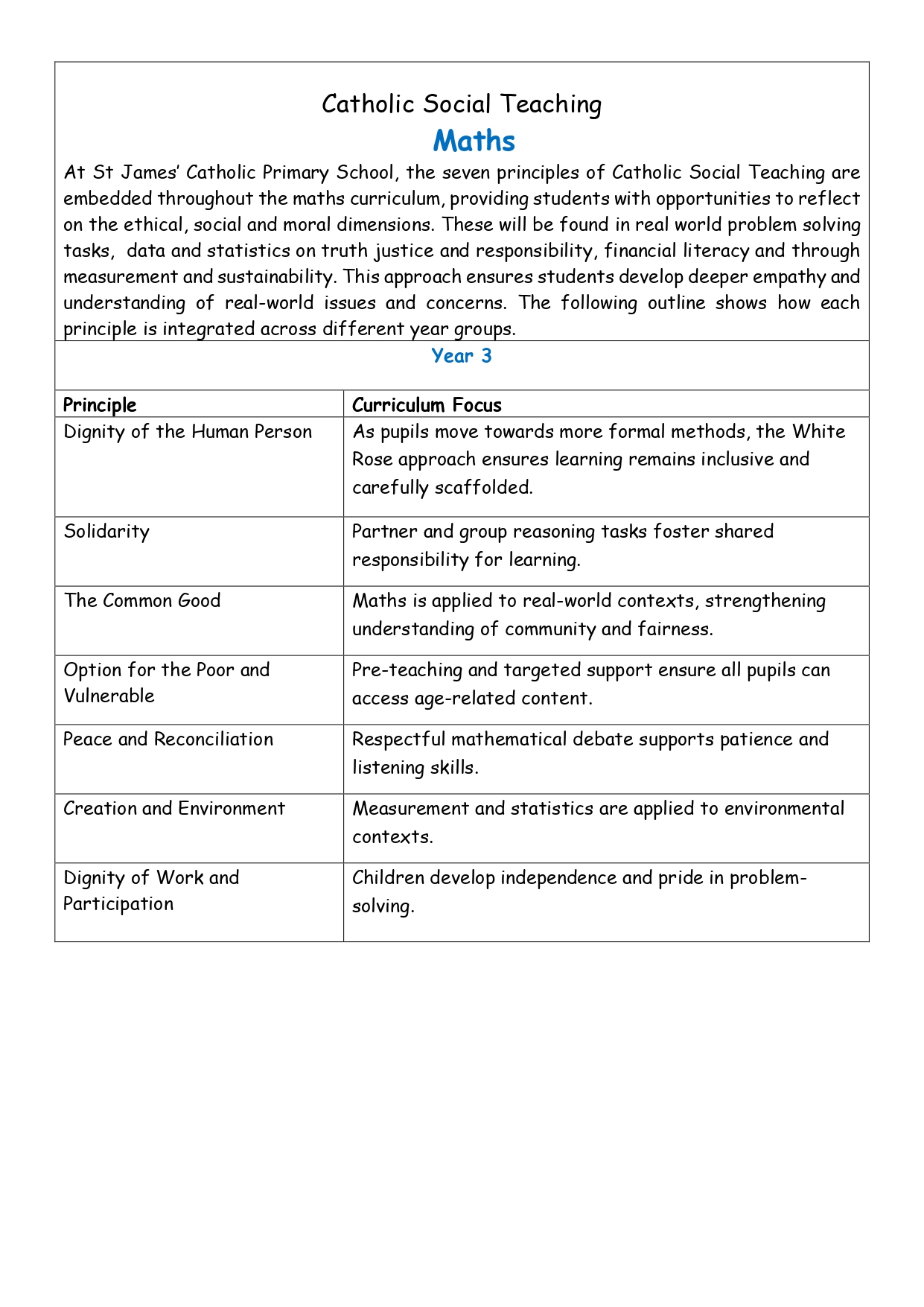
At St James’ Catholic Primary School, the seven principles of Catholic Social Teaching are embedded throughout the maths curriculum, providing students with opportunities to reflect on the ethical, social and moral dimensions. These will be found in real world problem solving tasks, data and statistics on truth justice and responsibility, financial literacy and through measurement and sustainability. This approach ensures students develop deeper empathy and understanding of real-world issues and concerns. The following outline shows how each principle is integrated across different year groups.
| Principle | Curriculum Focus |
| Dignity of the Human Person | At St James, the teaching of Maths through the White Rose approach upholds the dignity of every child by valuing all learners as capable mathematicians who can be masters of the subject. Lessons are carefully structured so that pupils build understanding step by step, allowing everyone to access the curriculum regardless of prior attainment. Concrete resources, visual representations, and mathematical talk ensure that pupils feel confident, respected, and supported, fostering self-belief and resilience in learning. |
| Solidarity | Maths lessons at St James promote solidarity by encouraging pupils to learn together and support one another. The White Rose approach emphasises discussion, partner work, and shared problem-solving, helping pupils to explain their thinking and listen to others. Through collaborative learning, children recognise that success in Maths is strengthened when they work as a community, valuing different perspectives and helping each other to succeed. |
| The Common Good | Maths at St James is taught as a subject that equips pupils with skills for life and for contributing positively to society. Pupils learn to reason, solve problems, and apply Maths to real-world contexts, helping them understand how maths supports everyday decisions and shared responsibilities. This prepares pupils to use their learning for the benefit of the wider community and the common good. |
| Option for the Poor and Vulnerable | At St James, Maths teaching reflects a strong commitment to support every child, including the most vulnerable learners. The White Rose approach allows teachers to identify misconceptions early and provide timely intervention, ensuring no child is left behind. At St James, children all learn together. Targeted support, adaptive teaching, and inclusive lesson design ensure that all pupils, regardless of background or additional needs, are given the opportunity to achieve and flourish in Maths. |
| Peace and Reconciliation | Maths lessons provide a calm, purposeful environment where respect, fairness, and patience are promoted. Through structured discussion and collaborative problem-solving in the White Rose approach, pupils learn to listen to differing viewpoints, resolve misunderstandings, and appreciate that mistakes are part of learning. This nurtures a classroom culture rooted in mutual respect and peaceful cooperation, where every child feels valued and praised by all. |
| Creation and Environment | The teaching of Maths at St James supports an understanding of care for creation by applying mathematical skills to real-life environmental contexts. Through White Rose problem-solving activities, pupils explore themes such as measurement, data handling, and sustainability, helping them understand how Maths can be used to care for the world around them. This encourages responsible stewardship and thoughtful engagement with environmental issues. |
|
Dignity of Work and Participation |
Maths at St James affirms the dignity of work by encouraging pupils to take pride in their effort, perseverance, and progress. The White Rose approach values mathematical reasoning and process over simply finding the correct answer, ensuring every child’s contribution is recognised. Pupils are actively involved in lessons, developing independence, confidence, and a strong work ethic that prepares them for future learning and participation in society. |
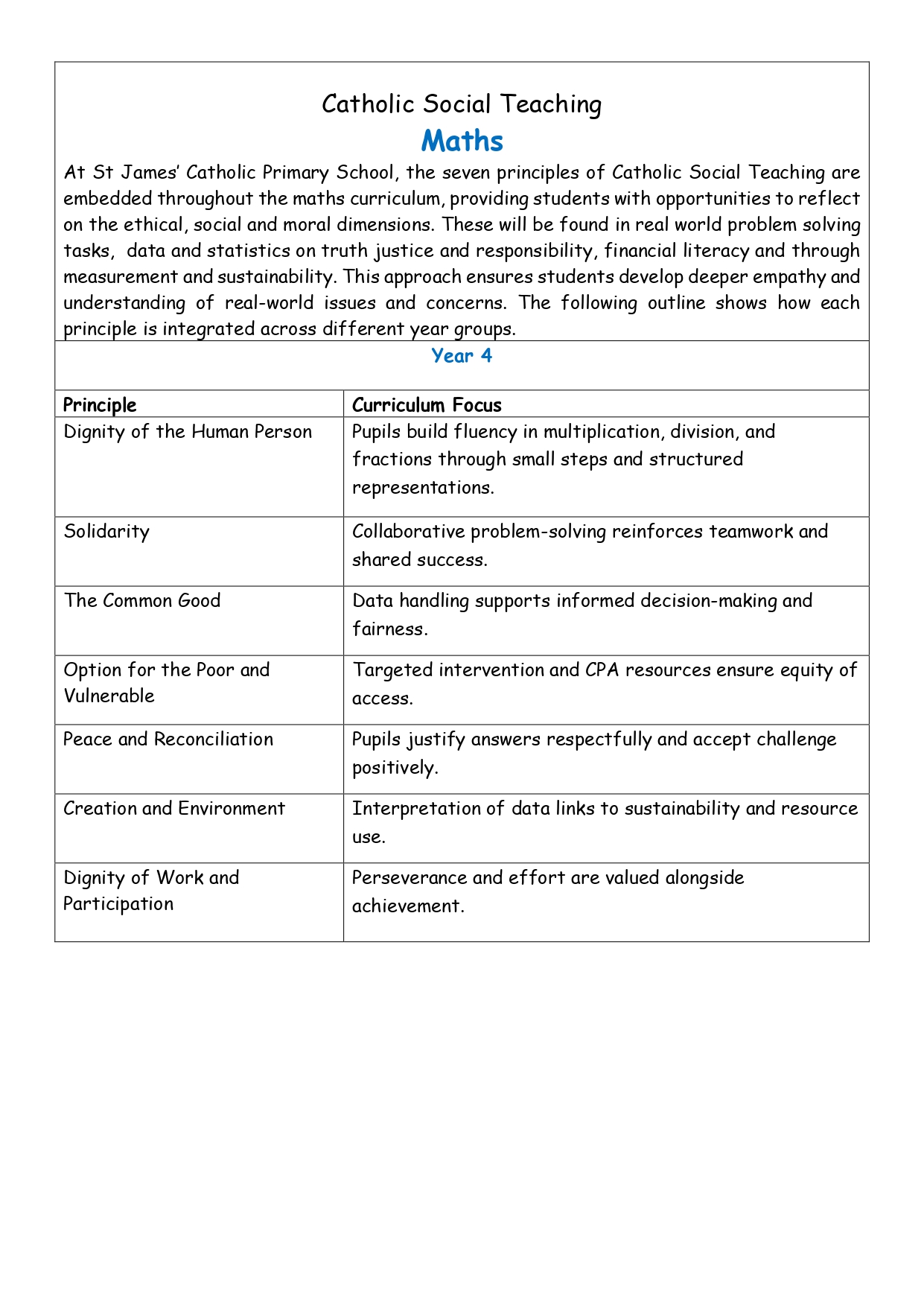
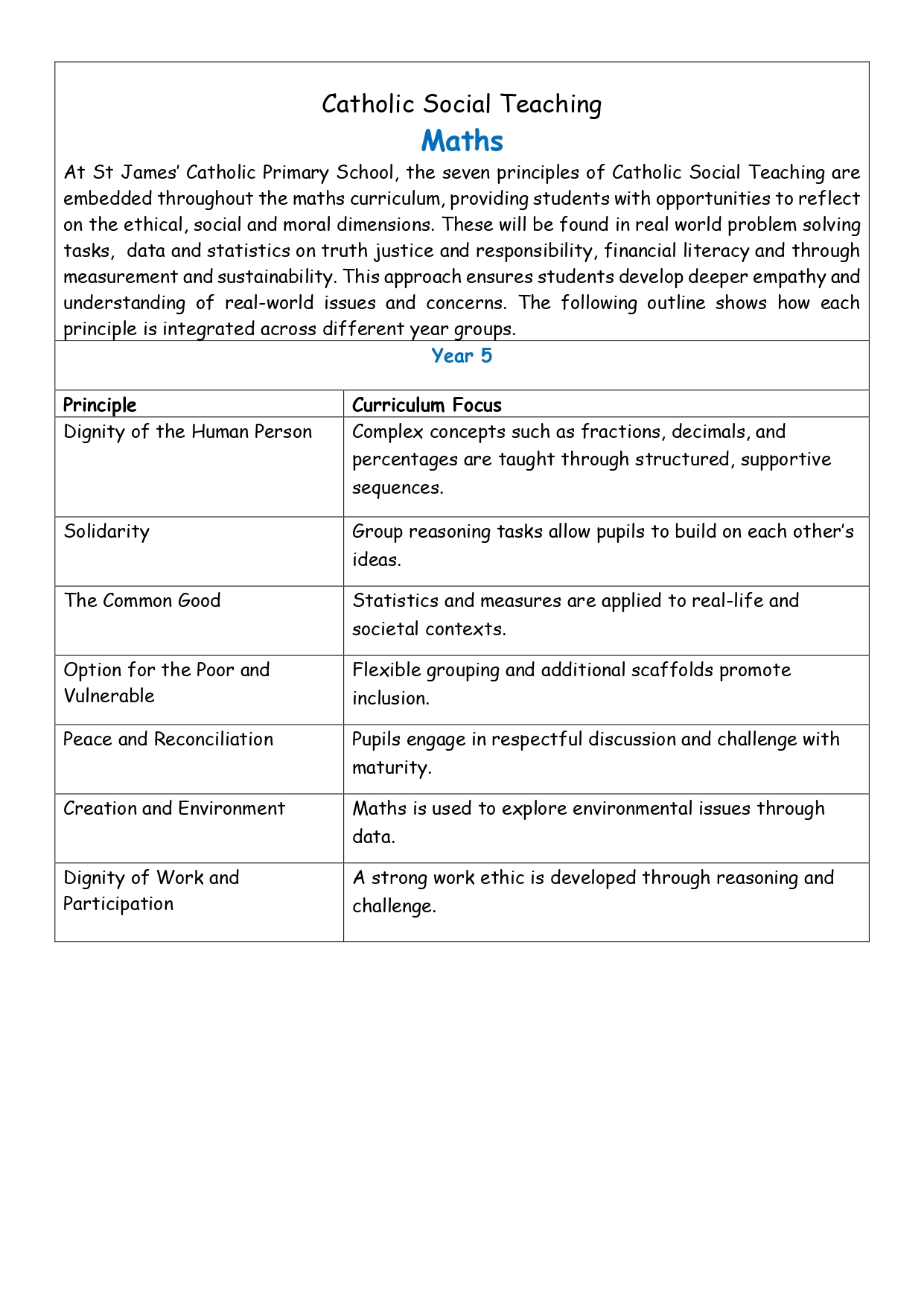
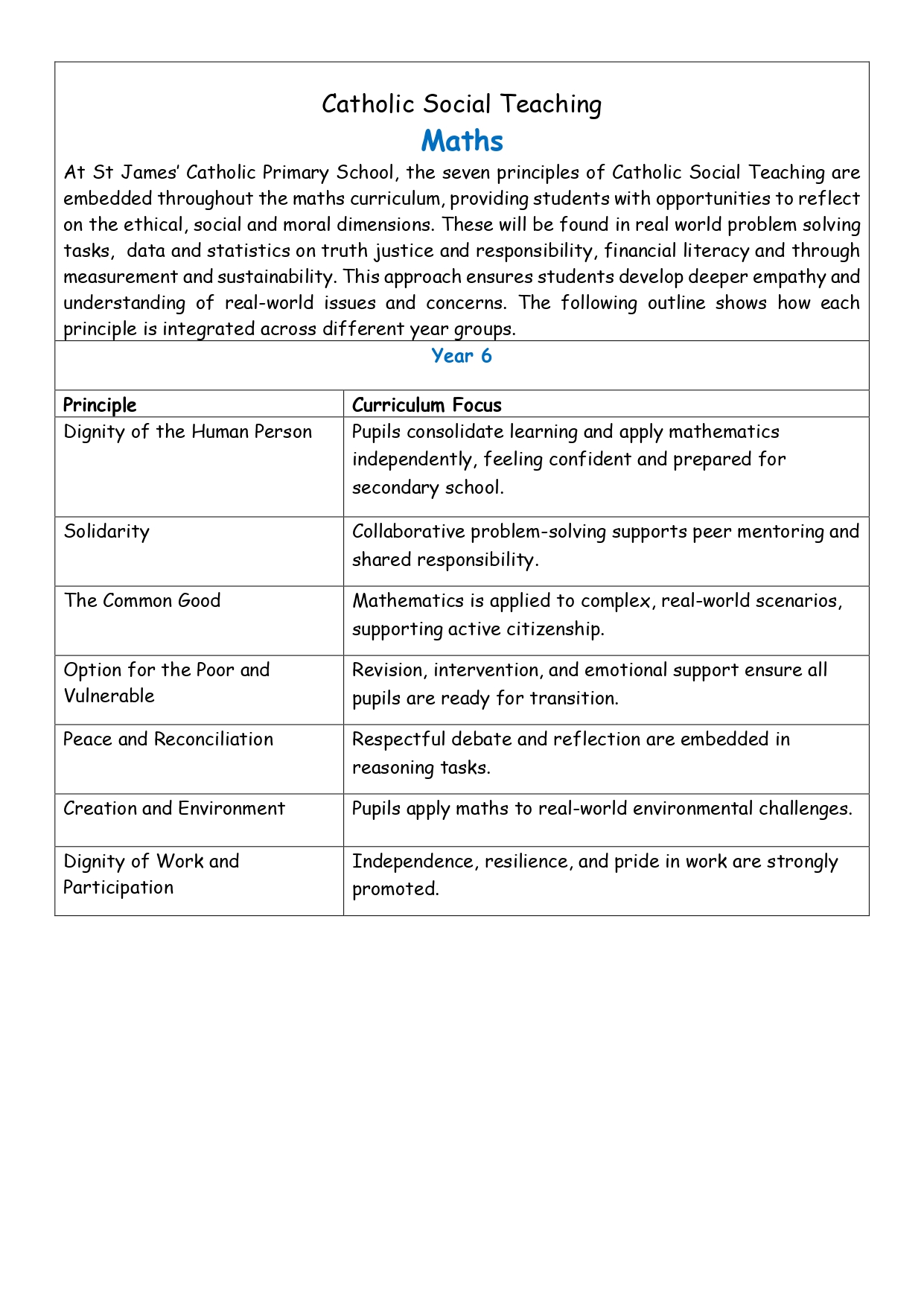
Catholic Social Teaching in Maths can be found below broken down into the year groups below:
Catholic Social Teaching in PE
At St James’ Catholic Primary School, the seven principles of Catholic Social Teaching are embedded throughout the personal, health and social curriculum, providing students with opportunities to reflect on the ethical, social and moral dimensions of physical education. This approach ensures students develop a deeper understanding of global responsibility, environmental stewardship and social justice. The following outline shows how each principle is integrated across different year groups through team work and problem solving activities.
| Principle | Curriculum Focus |
| Dignity of the Human Person | PE at St James promotes the dignity of every student by ensuring that all pupils are valued, respected, and encouraged to participate to the best of their ability. Lessons are inclusive and supportive, recognising that each child has unique strengths, needs, and talents. Through positive encouragement, fair treatment, and a focus on personal improvement rather than comparison, PE helps students develop confidence, self-worth, and respect for themselves and others. |
| Solidarity | Through team sports and cooperative activities, PE at St James fosters solidarity by teaching students to work together, support one another, and celebrate shared success. Pupils learn the importance of teamwork, empathy, and mutual responsibility, understanding that everyone has a role to play. This sense of belonging strengthens relationships and helps students appreciate the value of standing together as a community. |
| The Common Good | PE lessons at St James contribute to the common good by promoting healthy lifestyles, fairness, and shared responsibility. Students learn to follow rules, respect others, and create a safe environment where everyone can enjoy physical activity. By encouraging positive behaviour and collective participation, PE supports the wellbeing of the whole school community, not just individuals. |
| Option for the Poor and Vulnerable |
St James’ PE program is designed to be inclusive and accessible, ensuring that no child is excluded due to ability, background, or circumstance. Extra support, adapted activities, and encouragement are provided so that vulnerable or less confident students can fully participate. This reflects the school’s commitment to caring for those who may need additional help and ensuring equal opportunities for all. |
| Peace and Reconciliation | PE at St James teaches students how to manage competition in a respectful and peaceful way. Pupils are guided to resolve conflicts fairly, show sportsmanship, and forgive mistakes, both their own and others’. Through reflection and teacher guidance, PE becomes a space where reconciliation is practiced, helping students develop self-control, respect, and positive relationships. |
| Creation and Environment | Outdoor PE activities at St James help students appreciate and care for God’s creation. Pupils are encouraged to respect school grounds, use equipment responsibly, and understand the importance of caring for the environment. By engaging with nature through physical activity, students develop gratitude for creation and learn how their actions can protect and sustain it. |
| Dignity of Work and Participation | PE at St James recognises the dignity of effort and participation by valuing commitment, perseverance, and fair play over winning. Students are encouraged to take responsibility for their own learning, support leadership roles such as team captains, and respect the work of teachers and peers. This helps pupils understand the importance of contributing positively and responsibly in all areas of life. |
Catholic Social Teaching History
At St James’ Catholic Primary School, the seven principles of Catholic Social Teaching are embedded throughout the history curriculum, providing students with opportunities to reflect on the ethical, social and moral dimensions of historical events. This approach ensures students develop a deeper understanding of history while fostering a sense of justice, dignity and responsibility. The following outlines how each principle is integrated across different year groups.
| Principle | Curriculum Focus |
|
Dignity of the Human Person |
Year 1: Exploring how Florence Nightingale treated all people with respect and care simply because they were human. Year 2: Reflecting on how the Great Fire of London affected people differently and how society responded. Year 3: Exploring the Ancient Greek civilisation, considering how different societies treated individuals. Year 4: Considering the effects of the invasion of the Romans on the lives of Britons who were enslaved. Year 5: Exploring in the Early Islamic Civilization topic how people of all cultures and levels of society worked together, showing respect for people’s abilities and contributions. Year 6: Reflecting on how societies treat people who break the law while still respecting their human worth. |
| Solidarity |
Year 1: Mary Anning – Investigating how working cooperatively as a team with other scientists helped us discover more about Earth’s history. Year 2: The Great Fire of London – examining how people worked together to rebuild London. Year 5: Early Islamic Civilization – understanding how cooperation between scholars, merchants and communities helped spread ideas, showing how societies can work together. Year 6: Exploring how people and nations support one another during times of war and conflict. |
| The Common Good |
Year 1: Considering how Mary Anning’s work as a scientist benefited society as a whole and not just one person. Year 2: Discovering how Florence Nightingale strove to create conditions where everyone in society could live healthy, safe and fulfilling lives. Year 4: Exploring how the Romans through their inventions helped improve the lives of people in Britain through for example their building of roads, towns. Year 5: Examining how Anglo Saxons and Viking society cooperated with day to day life, assigned roles and promoted the wellbeing of the whole village and not just a few people. |
|
Option for the Poor and Vulnerable |
Year 1: Examining how Florence Nightingale chose to care for the weak and vulnerable when many people ignored their suffering during the Crimean War. Year 3: Stone Age to Iron Age – considering hoe early humans supported weaker member of society. Year 5: Exploring that in Islamic society charity was encouraged through the practice of Zakat, where wealthier people helped those who were less fortunate. |
|
Peace and Reconciliation |
Year 4: Roman Britain – exploring how conflicts between different groups were resolved following the invasion of Britain. Year 5: Exploring how Anglo Saxon and Viking communities made peace treaties and settled disputes through negotiation rather than ongoing fighting. Focus on reconciliation – restoring relationships and living in harmony despite past conflicts. Year 6: Examining that conflict shows the consequences when human dignity, fairness and justice is ignored. Teaches us that every human deserves respect, even in disagreement. |
|
Creation and Environment |
Year 3: Investigating how the Ancient Greeks were stewards of creation, using resources carefully so they last and help everyone. Year 4: Ancient Egypt relationship with the River Nile – how the environment shaped civilization. |
|
Dignity of Work and Participation |
Year 1: Mary Annings contributions as a working-class woman in science and shows how talent, hard work and curiosity can help everyone learn more about the world. Year 3: Stone Age to Iron Age – the development of farming, trade and tools. Year 4: Exploring the hierarchy of society in Ancient Egypt and considering whether workers or slaves were treated fairly. Year 5: Examining how people of all levels of society contributed through work, helping cities like Bagdad become centres of culture and learning. |
Catholic Social Teaching Geography
Geography At St James’ Catholic Primary School, the seven principles of Catholic Social Teaching are embedded throughout the geography curriculum, providing students with opportunities to reflect on the ethical, social and moral dimensions of both human and physical geography. This approach ensures students develop a deeper understanding of global responsibility, environmental stewardship and social justice. The following outline shows how each principle is integrated across different year groups.
| Principle | Curriculum Focus |
| Dignity of the Human Person |
Year 1: Exploring how everyone in the local area of Hebburn matters. Year 2: Comparing UK and Kenya – understanding how different communities live and their equal dignity. Year 3: Investigating how rivers facilitate connections between people, places, and communities. Year 4: Studying the effects of natural disasters of volcanoes and earthquakes on peoples lives and communities. Year 5: Examining access to clean water and energy as fundamental human rights, with an emphasis on promoting the fair distribution of global resources. Year 6: Reflecting through biomes topic on how all communities deserve a good quality of life, no matter where they live. |
| Solidarity |
Year 1: Developing an understanding of different climates and how extreme weather affects people differently. Year 4: Studying the effects of supporting people and communities affected by natural disasters – in terms of sending aid, food and rescue teams. Year 5: Exploring our shared responsibility within a global community by recognising how the use of natural resources impacts people worldwide and examining ways to support sustainability and assist communities in need. Year 6: Examining the importance of supporting indigenous communities and protecting rainforest environments. |
| The Common Good |
Year 1: Exploring the importance of sharing the Earth’s resources fairly, including water and food, so that everyone can live well. Year 2: Learning about the similarities and differences of life in the UK and Kenya – recognising the interconnectedness of all people and places. Year 4: Exploring how countries affected by natural disasters - such as volcanic eruptions and earthquakes - design and construct safer buildings, as well as create effective emergency response plans. Year 5: Investigating how the use of renewable energy sources supports the sustainable and equitable preservation of global resources. |
|
Option for the Poor and Vulnerable |
Year 2: Comparing Kenya and the Uk – understanding economic disparities and challenges different communities face. Year 3: Journey of a River – examining communities’ reliance on rivers for clean water and the effects of pollution and flooding. Year 5: Exploring that we should prioritise helping poorer communities, who often lack access to clean water, energy or fertile land, through fair trade and sustainable development. |
|
Peace and Reconciliation |
Year 1: Exploring hot and cold places – understanding how climate change can cause global tensions over resources. Year 4: Reflecting on the aftermath of volcanic eruptions and earthquakes, focusing on how communities promote cooperation, fairness, and the rebuilding of relationships. Year 5: Examining how resource scarcity impacts communities and nations, and how promoting peace requires resolving resource-related disputes fairly and cooperatively. Year 6: Demonstrating that conflict arises when human dignity, fairness, and justice are disregarded, and highlighting the need for equitable solutions that respect both people and the environment. |
|
Creation and Environment |
Year 1: Understanding that diverse climates form part of a shared world and recognising the responsibility to care for animals and environments in regions such as hot deserts and polar areas. Year 3: Recognising rivers as part of God’s creation and emphasising our responsibility to care for them and their associated wildlife. Year 4: Examining how support for communities in disaster-prone areas helps restore the environment, upholding both human dignity and care for creation. |
|
Dignity of Work and Participation |
Year 1: Learning about people who help in the community, recognising the different roles they undertake and the valuable contribution they make. Year 3: Journey of a River – examining the essential roles of farmers, fishermen, and river conservation workers. Year 4: Exploring how all individuals can contribute to and participate in rebuilding their community after natural disasters such as earthquakes or volcanic eruptions. Year 5: Investigating the need for safe, fair, and sustainable working practices in natural-resource industries, emphasising that all people have the right to work responsibly and to participate in decisions about resource use. |
Catholic Social Teaching Science
At St James’ Catholic Primary School, the seven principles of Catholic Social Teaching are embedded throughout the science curriculum, providing students with opportunities to reflect on the ethical, social and moral dimensions of scientific enquiry. This approach ensures students develop a deeper understanding of global responsibility, environmental stewardship and social justice. The following outline shows how each principle is integrated across different year groups.
| Principle | Curriculum Focus |
| Dignity of the Human Person |
Pupils develop an understanding of the value and uniqueness of every individual through the study of the human body and health. EYFS: Pupils begin to recognise their own bodies and basic self-care needs, including hygiene and healthy routines. Key Stage 1: Pupils identify basic human needs (nutrition, water, air) and understand the importance of keeping healthy. Key Stage 2: Pupils study more complex body systems (e.g. skeletal system in Year 3, circulatory system in Year 6) and evaluate lifestyle choices, recognising that all individuals deserve care, respect and access to health and wellbeing. |
| Solidarity |
The science curriculum promotes collaboration, shared responsibility and respect for others’ contributions. EYFS: Pupils engage in shared exploration and cooperative play within the natural world. Key Stage 1: Pupils participate in simple group investigations, learning to share resources and communicate findings. Key Stage 2: Pupils plan and carry out fair tests collaboratively, evaluate evidence collectively, and explore how global scientific challenges (e.g. climate change) require cooperation across communities and nations. |
| The Common Good |
Pupils understand how scientific knowledge and innovation contribute to the wellbeing of society. EYFS: Pupils learn to care for their immediate environment and shared spaces. Key Stage 1: Pupils explore plants, animals and habitats, recognising the importance of caring for living things. Key Stage 2: Pupils examine how science supports communities (e.g. renewable energy in Year 5, water cycles and conservation), considering how scientific advancements should benefit all. |
|
Option for the Poor and Vulnerable |
Pupils are encouraged to reflect on inequality and the role of science in addressing global challenges. EYFS: Pupils begin to understand that some people may need additional support to stay healthy and safe. Key Stage 1: Pupils explore basic needs and begin to recognise that access to resources is not equal worldwide. Key Stage 2: Pupils investigate issues such as access to clean water, nutrition and healthcare, linking scientific learning (e.g. states of matter, microorganisms, or health) to real-world contexts and ethical responsibility. |
| Peace and Reconciliation |
Science learning fosters respectful dialogue, critical thinking and resolution through evidence. EYFS: Pupils develop turn-taking and cooperative behaviours during exploration. Key Stage 1: Pupils begin to discuss ideas and listen to others during investigations. Key Stage 2: Pupils engage in reasoned scientific discussion, using evidence to resolve differences of opinion and recognising how scientific developments can promote peace, such as through medicine and technology. |
| Creation and Environment |
Stewardship of the Earth is a central theme, with pupils developing an understanding of environmental responsibility. EYFS: Pupils explore the natural world, observing changes and showing care for living things. Key Stage 1: Pupils study seasonal changes, plants and habitats, developing early awareness of environmental care. Key Stage 2: Pupils deepen their understanding of ecosystems, adaptation, climate change and sustainability (e.g. habitats in Year 4, Earth and space in Year 5, environmental impact in Year 6), recognising their role in protecting God’s creation. |
|
Dignity of Work and Participation |
Pupils recognise the value of scientific work and their own participation in enquiry. EYFS: Pupils take part in exploratory activities, developing curiosity and engagement. Key Stage 1: Pupils learn about the role of scientists and inventors, understanding how their work helps others. Key Stage 2: Pupils study significant scientists and their contributions, develop independence in scientific enquiry, and understand how careers in science contribute to the common good. |
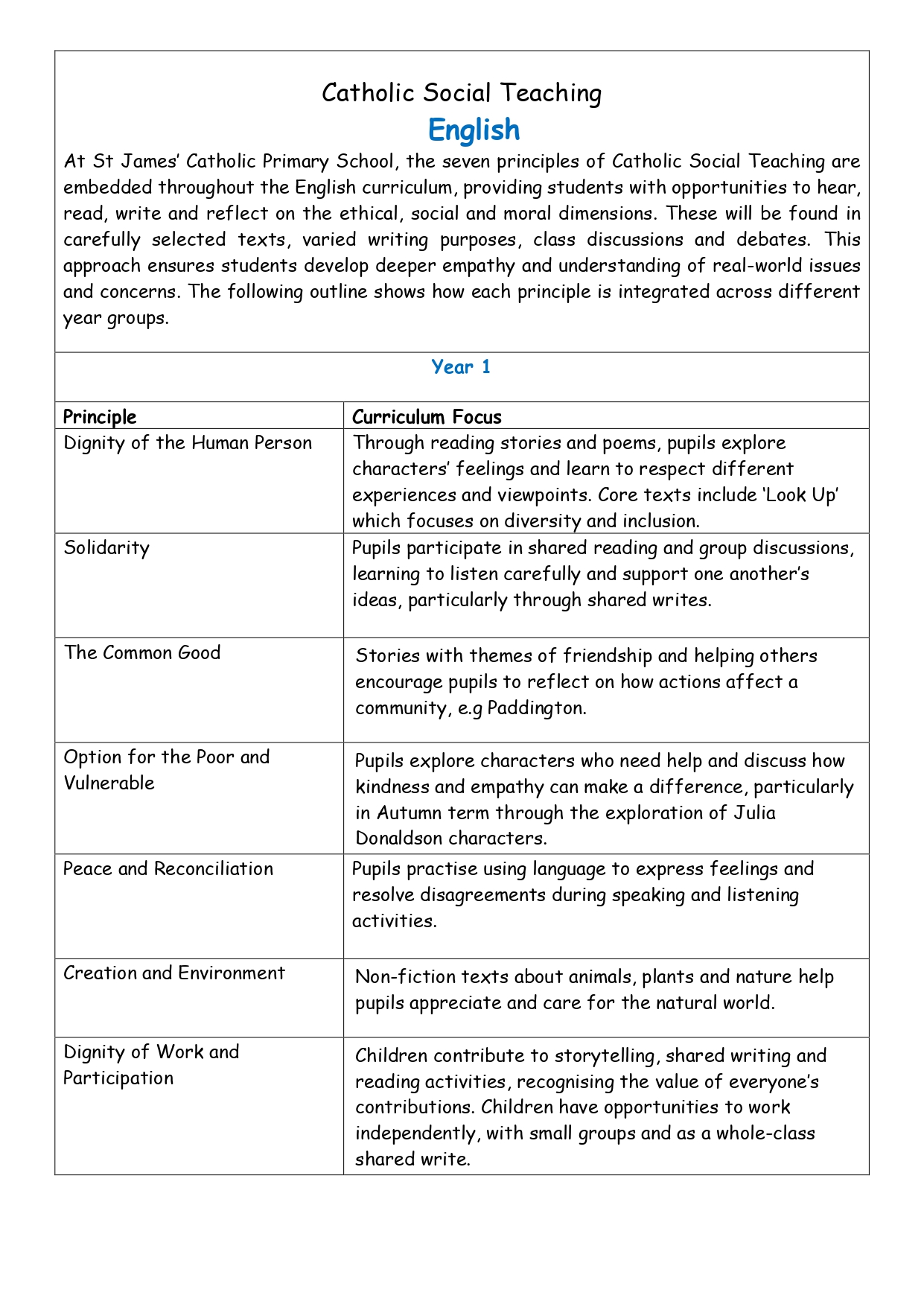
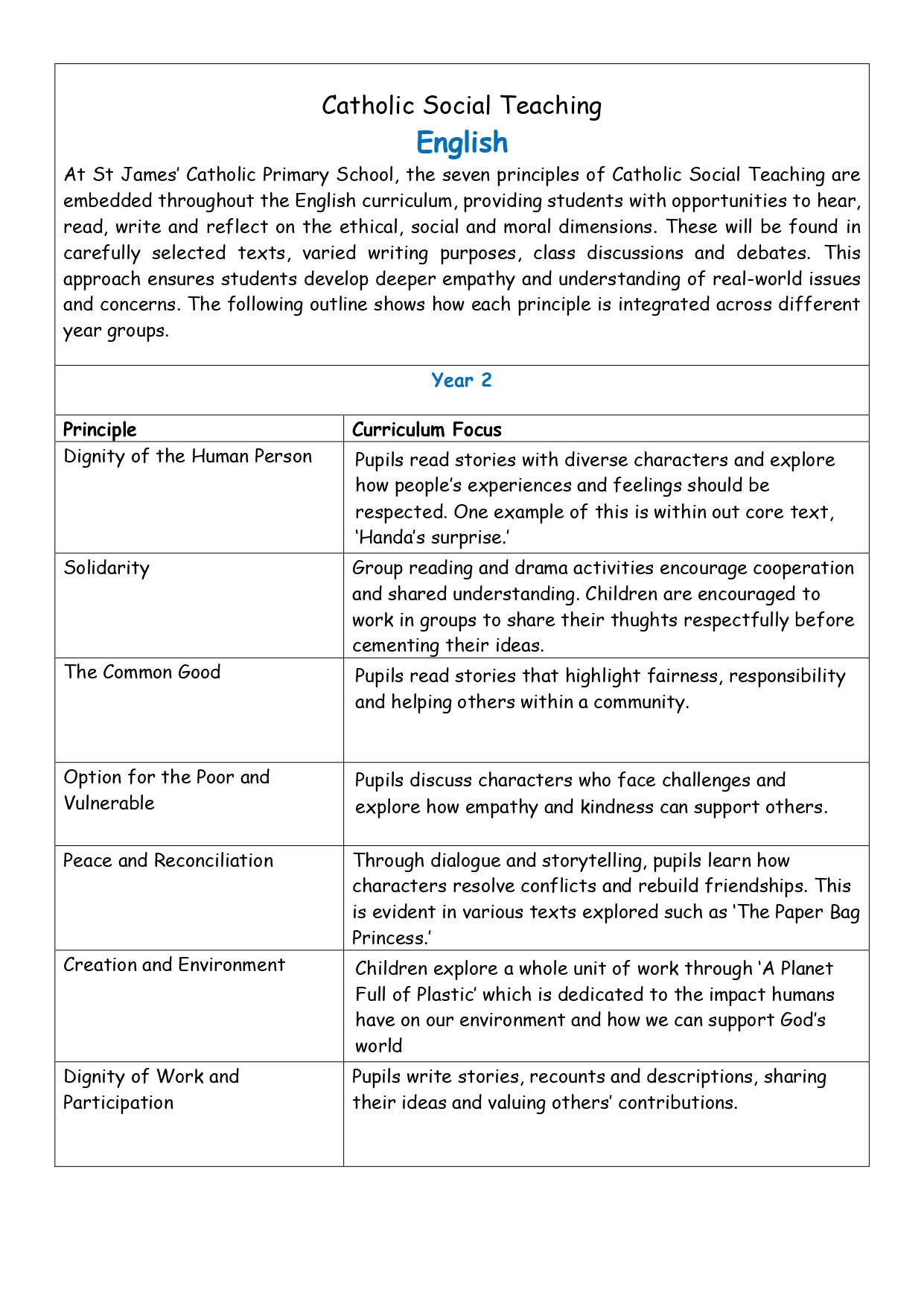
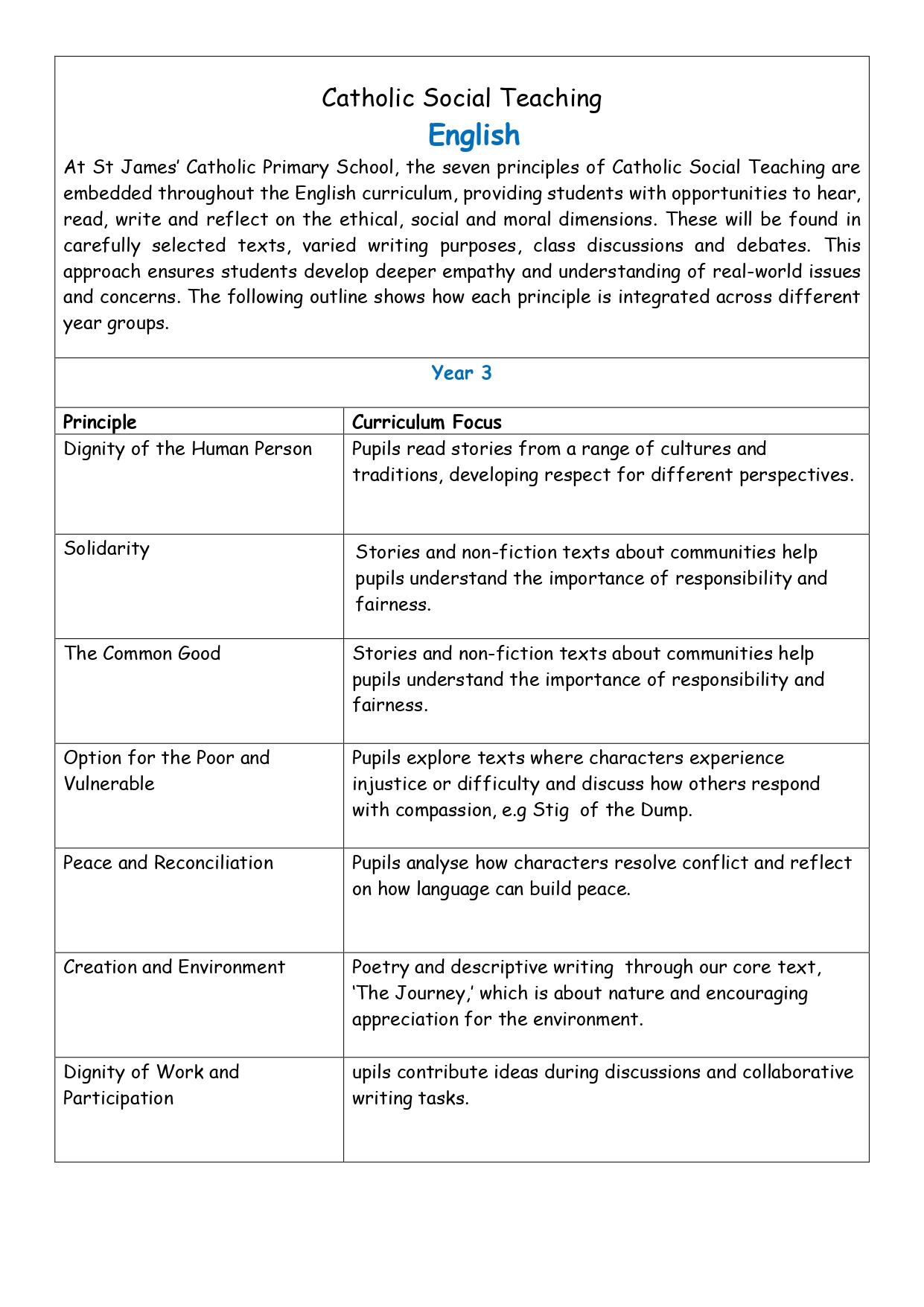
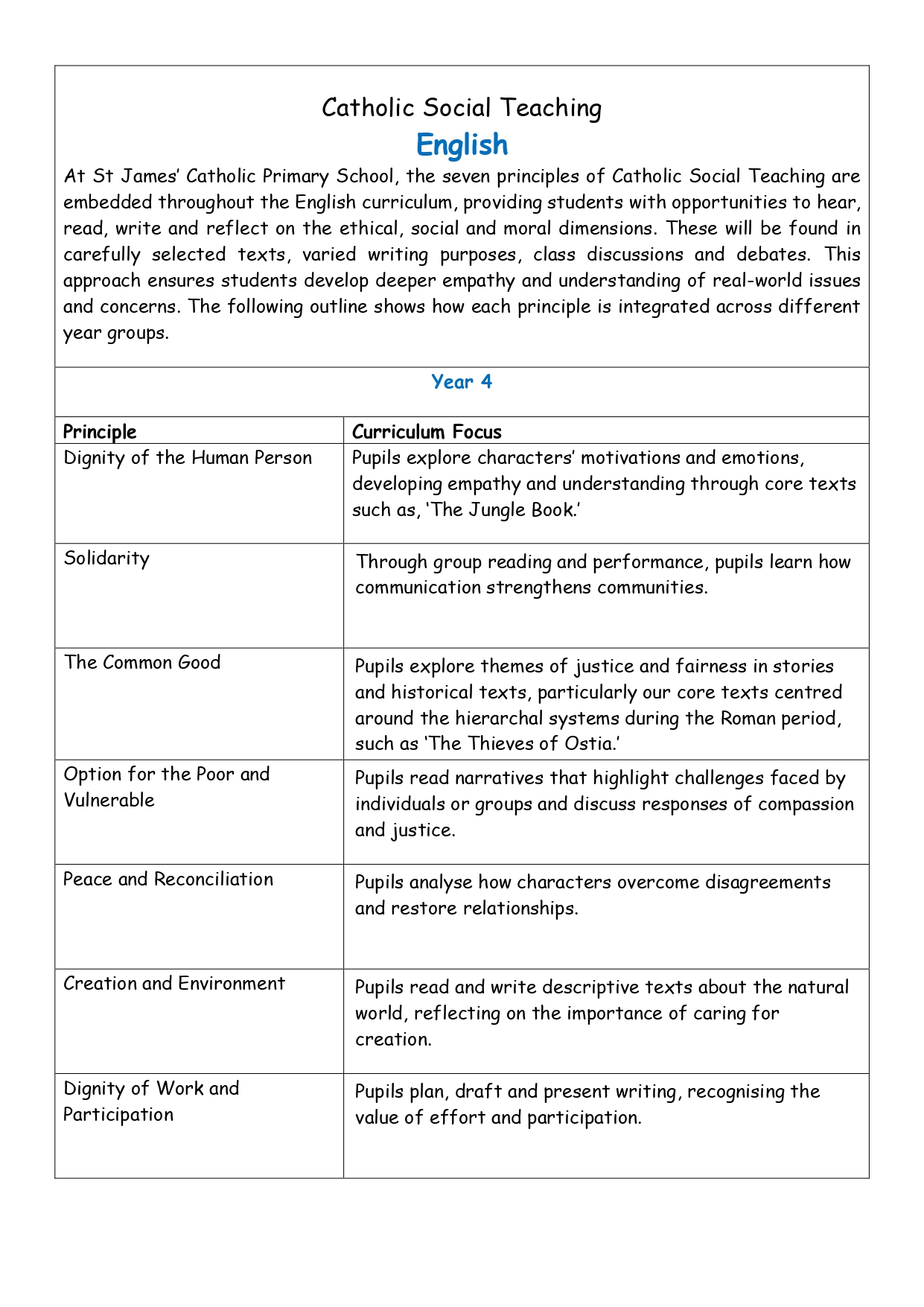
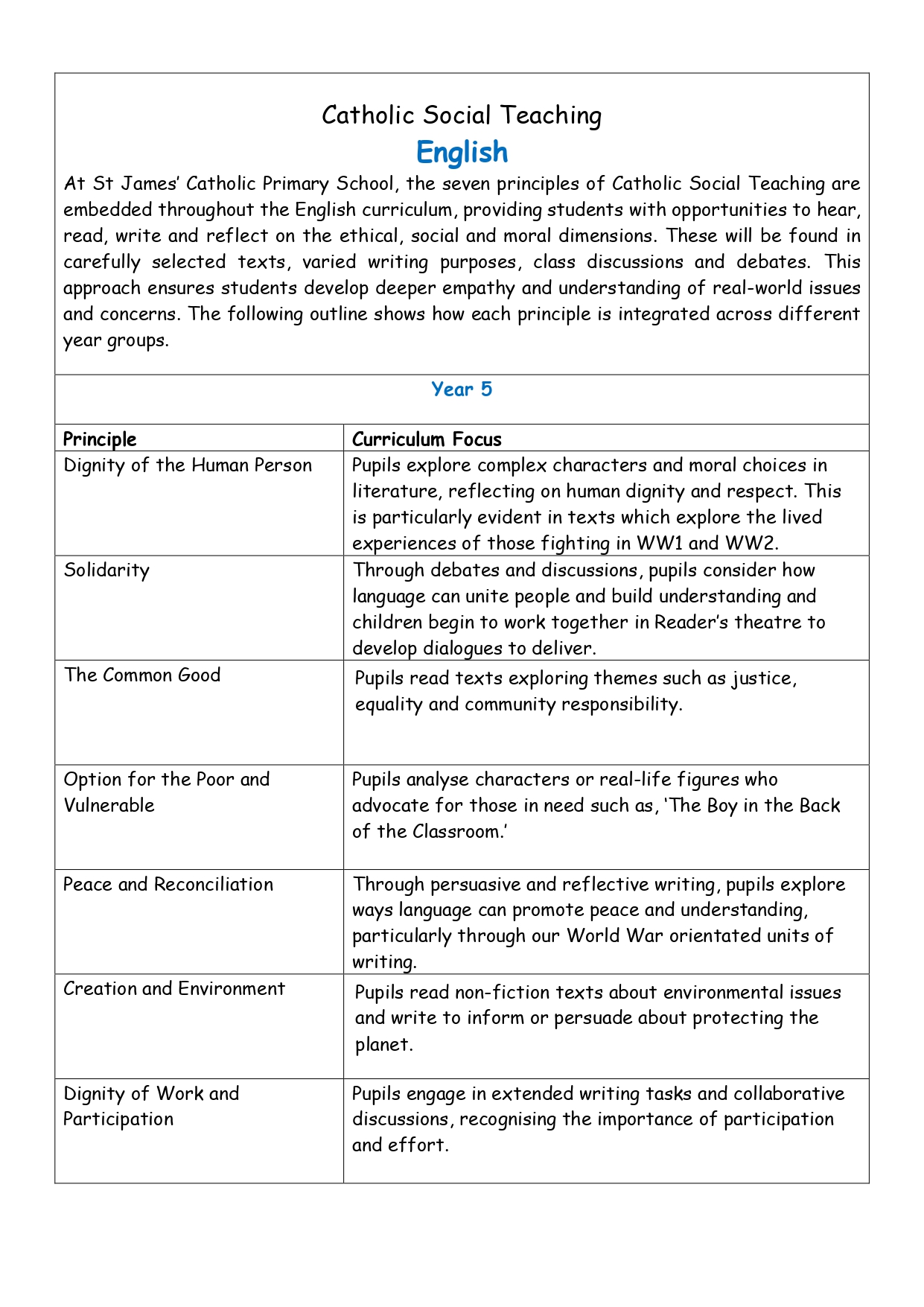
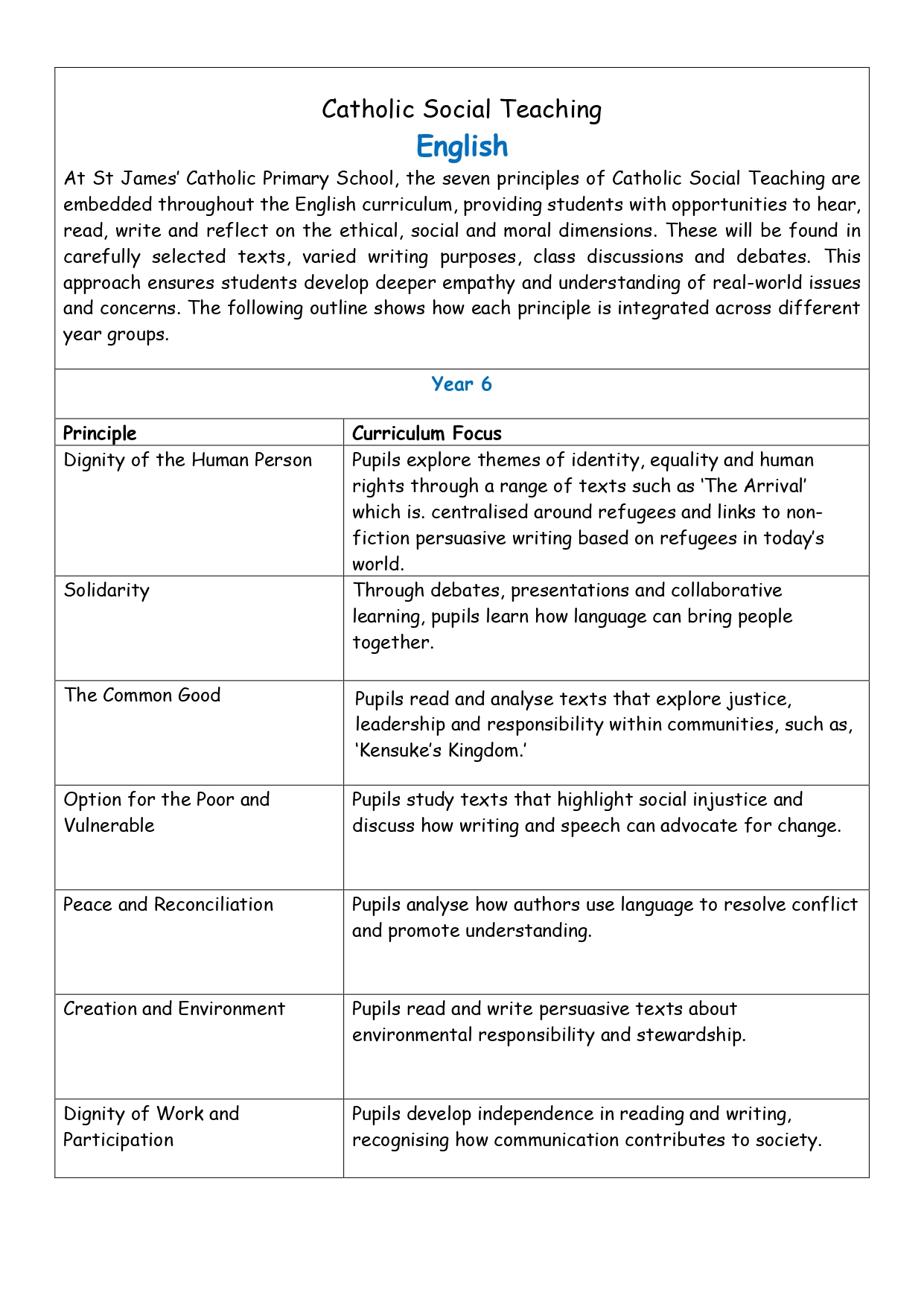
Catholic Social Teaching in English
At St James’ Catholic Primary School, the seven principles of Catholic Social Teaching are embedded throughout the English curriculum, providing students with opportunities to hear, read, write and reflect on the ethical, social and moral dimensions. These will be found in carefully selected texts, varied writing purposes, class discussions and debates. This approach ensures students develop deeper empathy and understanding of real-world issues and concerns. The following outline shows how each principle is integrated across different year groups.
| Principle | Curriculum Focus |
| Dignity of the Human Person | Exploring characters’ feelings, rights, and responsibilities in texts; promoting respectful language in speaking and writing; reflecting on fairness and justice. Participation in World Book Day celebrates every child’s voice and identity through reading and storytelling. |
| Solidarity | Studying themes of community, teamwork, and belonging; engaging in collaborative writing and discussions. Whole-school events such as spelling bees encourage teamwork, mutual support, and shared achievement. |
| The Common Good | Analysing how actions affect others; writing persuasive texts about community issues; participating in debates. School participation in community-linked events (e.g. local poetry competitions) fosters a sense of contributing to the wider good. |
|
Option for the Poor and Vulnerable |
Reading and discussing texts that highlight inequality and injustice; writing to raise awareness or advocate for change. Events like World Book Day promote inclusive access to books and literacy for all pupils. |
| Peace and Reconciliation | Exploring conflict and resolution in narratives; role-playing and writing reflective pieces on forgiveness. Collaborative activities such as spelling bees promote respectful competition and positive relationships. |
| Creation and Environment | Studying environmental themes in fiction and non-fiction; writing reports, poems, or persuasive texts about caring for the planet. Local poetry competitions may include themes linked to the environment and local area, encouraging stewardship. |
|
Dignity of Work and Participation |
Learning about different roles in society; encouraging all pupils to participate actively in discussions and performances. Participation in spelling bees and local poetry competitions— particularly those linked to local history and community—celebrates effort, aspiration, and pride in pupils’ contributions. |
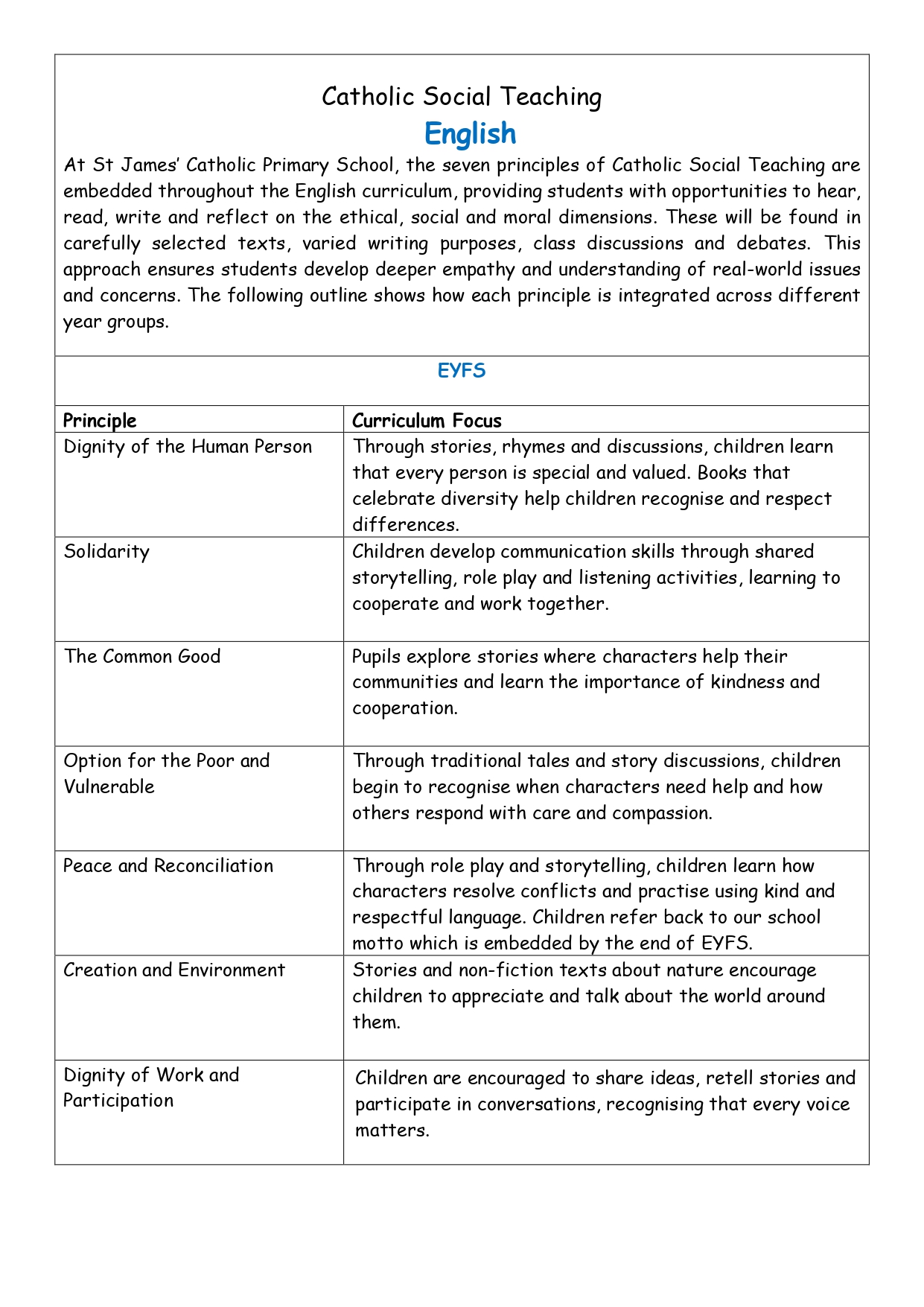
Catholic Social Teaching in Maths can be found below broken down into the year groups below:

In school we use CAFODs images which help the children follow the nine principles.
Oscar Romero
This week we have been celebrating the life and work of St Oscar Romero - an Archbishop who was dedicated to the needs of the poor and the most vulnerable members of society - who inspires us to act out the nine principles of Catholic Social Teaching. Our lessons this week have helped us to look more closely at protecting God's world, the dignity of all human beings, working in solidarity with God's family, ways to find peace and giving everyone a voice to say how they feel. We have achieved this through hearing the parable of the sheep and goats in RE, the importance of clean water for all in Geography, sharing in maths and being eco warriors for God's world in science. In PHSE we have looked at Romero Crosses and how they highlight the importance of community and friendship and in art, self-portraits have helped us to see that everyone is unique however equally important to God. Our Oscar Romero week has also included a Celebration of the Word dedicated to St Romero, a fundraising walk for CAFOD, a school council meeting and a community Mass at St James' RC church.
Prayer Stations
As part of our commitment to the Year of Hope 2025, our children took part in a reflective school pilgrimage, journeying through seven prayer stations set up across the school. Each station focused on a core Catholic principle, carefully prepared by class teachers to create a space for prayer, reflection, and discussion.
As the children moved from station to station, they explored how these principles guide us to act with compassion, kindness, and justice - both in our local communities and across the globe. Our children shared how they can be a force for good and help build a better, more hopeful world for everyone.
An audience with Pope Leo
Father Chris, brother of Mrs Scott and friend to St. James School had an audience with Pope Leo XIV to discuss the work he does with Citizens UK. Citizens UK is an organisation which supports social issues and tries to implement changes such as fair living wages for all.
CAFOD – Creative for Justice
We took part in CAFODs get creative for climate justice campaign. We understand how important it is to care for God’s beautiful earth.
Our school artwork featured in part of the exhibition at the Houses of Parliament. What a fantastic opportunity to show our love.
We are proud to feature in CAFOD’s celebration of 10 Years of Laudato Si’

Joanna Scott, St. James’ Catholic Primary School in Hebburn
“CAFOD’s LiveSimply Award gave our school the perfect opportunity to support Pope Francis’ plea in Laudato Si’ to live simply, sustainably and in solidarity with the poor.
To help our families to live more sustainably, we asked them to reduce their carbon footprint -including fewer school drop offs in cars, waste free packing for school lunches and purchasing recycled clothing and school uniforms.
To live more simply we encouraged our families to get out into their local environment and to play games which rely less on technology.
To show our solidarity for the poor we promoted the importance of buying Fairtrade goods, raised funds for CAFOD’s global projects, and supported CAFOD’s efforts to protect small famers.
Our LiveSimply Award is now displayed proudly in our school. However, our mission to look after God’s world and the more vulnerable people who live within in it goes on indefinitely through the continued selfless work of our children, staff, families and wider school community.”
Eco Warriors – Uniform
At St. James we know that recycling clothes is crucial for environmental conservation, resource management, and reducing waste. We are delighted to showcase our pre-loved uniform. We will be rotating our rail once every two weeks; this weeks category is sweatshirts and PE kit. The uniform is all freshly washed and pressed, thank you to our lovely Mrs Snaith and our SVP for their help with this. Our uniform rail will be at the front office and anyone is welcome to browse, this is entirely free of charge as part of our eco vision and ongoing love and protection of God’s beautiful earth.
Eco Warriors – Battery Recycling
At St. James we are proud to be Eco Warriors! We even have a battery recycling point in the school office.
Battery recycling is essential for protecting our environment and is an easy way to play your part in protecting the planet and showing our ongoing love and respect of God’s earth.. So, next time your battery runs out—recycle it! Let’s make battery recycling a bright spot at St. James. Any batteries can be brought into the school office where they will be collected for recycling!
Red Nose Day
On Friday 21st March children were invited to attend school in non-uniform to raise money for Comic Relief.
Comic Relief is there for people who are facing the toughest times of their lives. All year-round, the money donated to Comic Relief works hard to support some incredible projects making a change to people’s lives across the UK and around the world. In fact, over the last few years, Comic Relief funding has helped to support 3 million people.
Together we raised over £100. Every donation makes a very real difference to people in the UK and around the world.

NSPCC Number Day
We were delighted to support NSPCC Number Day by raising money to support their vital services, such as Childline- the helpline that’s always there for children and young people whatever their problem or concern.
The theme for the day was Dress up for Digits and children were invited to come in non-uniform, wearing an item of clothing with a number on it. Together our cake sale raised £223.36 for NSPCC!

LiveSimply Award!
As you already know this year we have been working to achieve CAFOD’s Live Simply Award. This is an award given to schools and parishes in response to Pope Francis’ invitation to ‘Laudato Si’ – to work with generosity and tenderness in protecting God’s world.
We are DELIGHTED to confirm that our school has now achieved the LiveSimply award. Despite the fact that our children are currently split over three sites we have still come together to demonstrate that we can live simply, sustainable and in solidarity with the world’s poorest communities.
This award celebrates what we have already done and inspires us to do more. It helps us to live not just more simply but more fully. LiveSimply is very much a journey which we hope to continue for many years to come.
This is a huge achievement for our school and we hope to celebrate our success by continuing our faith inspired actions. Our commitment to LiveSimply is a vital part of our Catholic life and the overall mission of our school.
Thank you to everyone who has supported us in achieving this award, special thanks to Mrs Scott, our Faith in Action Group our Mini Vinnies and for all those who have donated to our many fundraising events, most recently, CAFOD’s big Lent Walk. The feedback we have received is wonderful “the pupils were outstanding in the clarity and commitment they show to your LiveSimply journey.” We have produced outstanding work and this is a credit to our community.